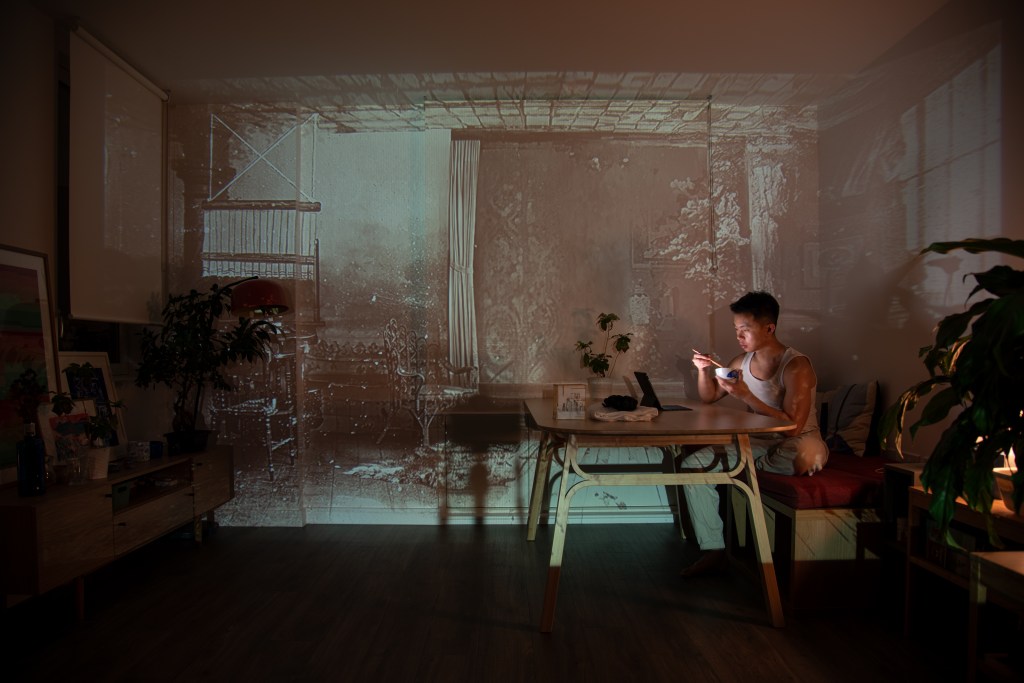
Rehearsal for 302 (2025-2026)
While researching the history of Chinese servants in colonial Singapore, I came across a photograph from around 1890, numbered 303 and captioned ‘Chinese boy serving his master’, in the National Archives of Singapore. Shot by the studio of Gustav Richard Lambert, it shows a Chinese man slightly hunched over, carrying a tray, attending to a fair-skinned man whose back is turned to the camera. Nothing was recorded of his identity: no name, no age, no family, no origins.
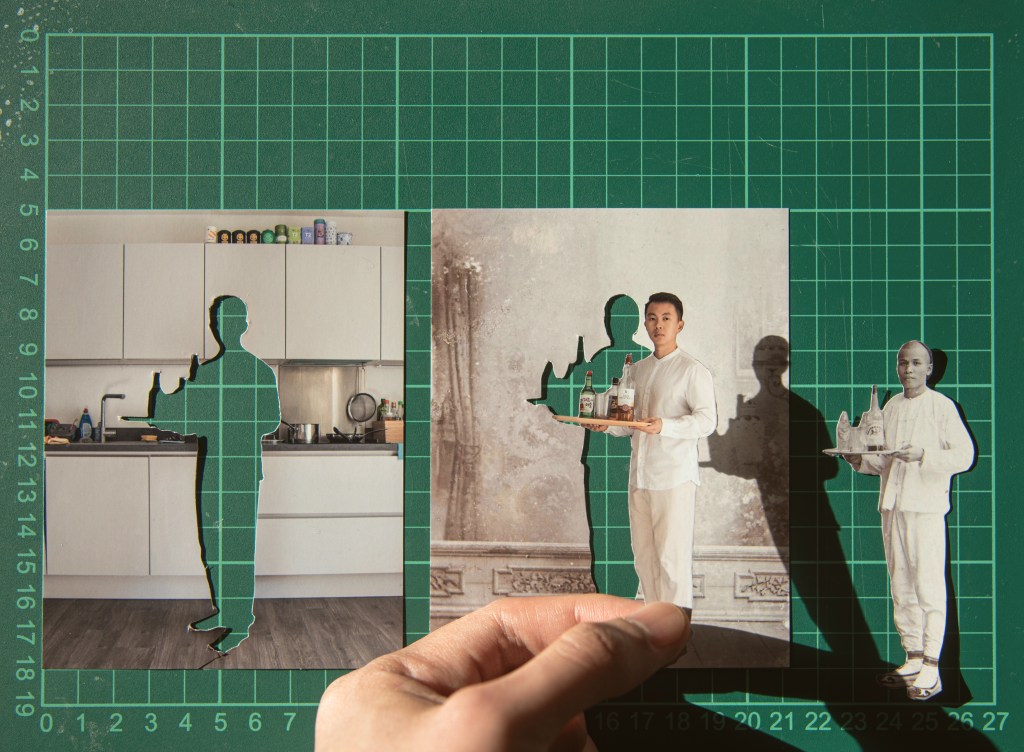
Later, while researching the Dutch Empire through the image collection of the Koninklijk Instituut voor Taal-, Land- en Volkenkunde, I unexpectedly encountered the same man. Standing alone before a backdrop with a tray of drinks, he is captioned ‘Chinese boy on duty’, numbered 301, from the same studio.
Two photographs of one man, held in the archives of two countries. Who was he? Where did he come from? What of image 302, was it also a picture of him?
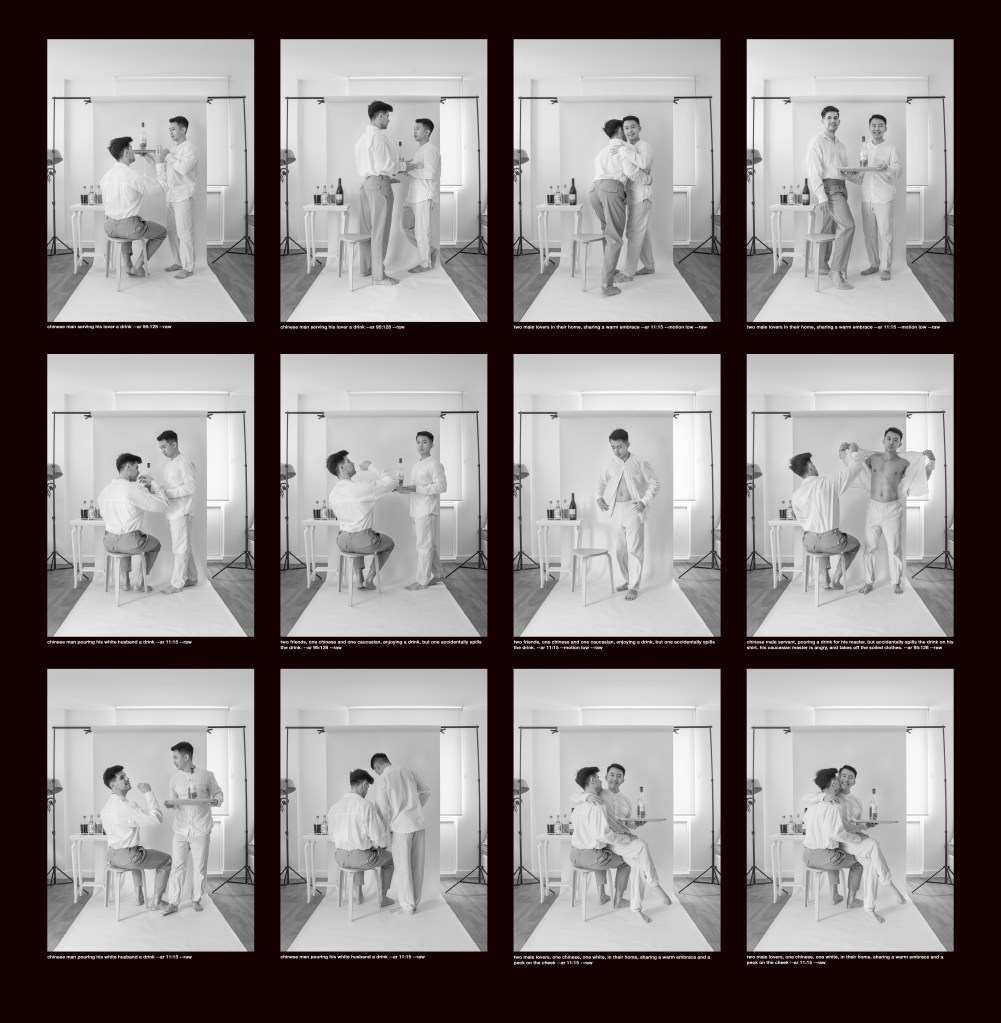
This missing image became the starting point for Rehearsal for 302, an attempt to imagine what the archive left out. To rehearse towards it, I put the two existing images through a sequence of latent space interpolation, using Midjourney to conjure the in-betweens: encounters between a Chinese man and his supposed white master. I transformed the resulting images further through reenactments, collage, layering, and projection, pushing the flat photograph into three-dimensional space.
My body is central to this work. I embody this anonymous man, held in the archive without a name. As a Singaporean-Chinese now living in London, I project onto him my own experiences of longing, intimacy, and desire — all that escapes the archive.
Exhibition Summary
- Exhibited:
- Foam, Amsterdam (2026)
- Featured:
- Foam Magazine no.68 (2026)
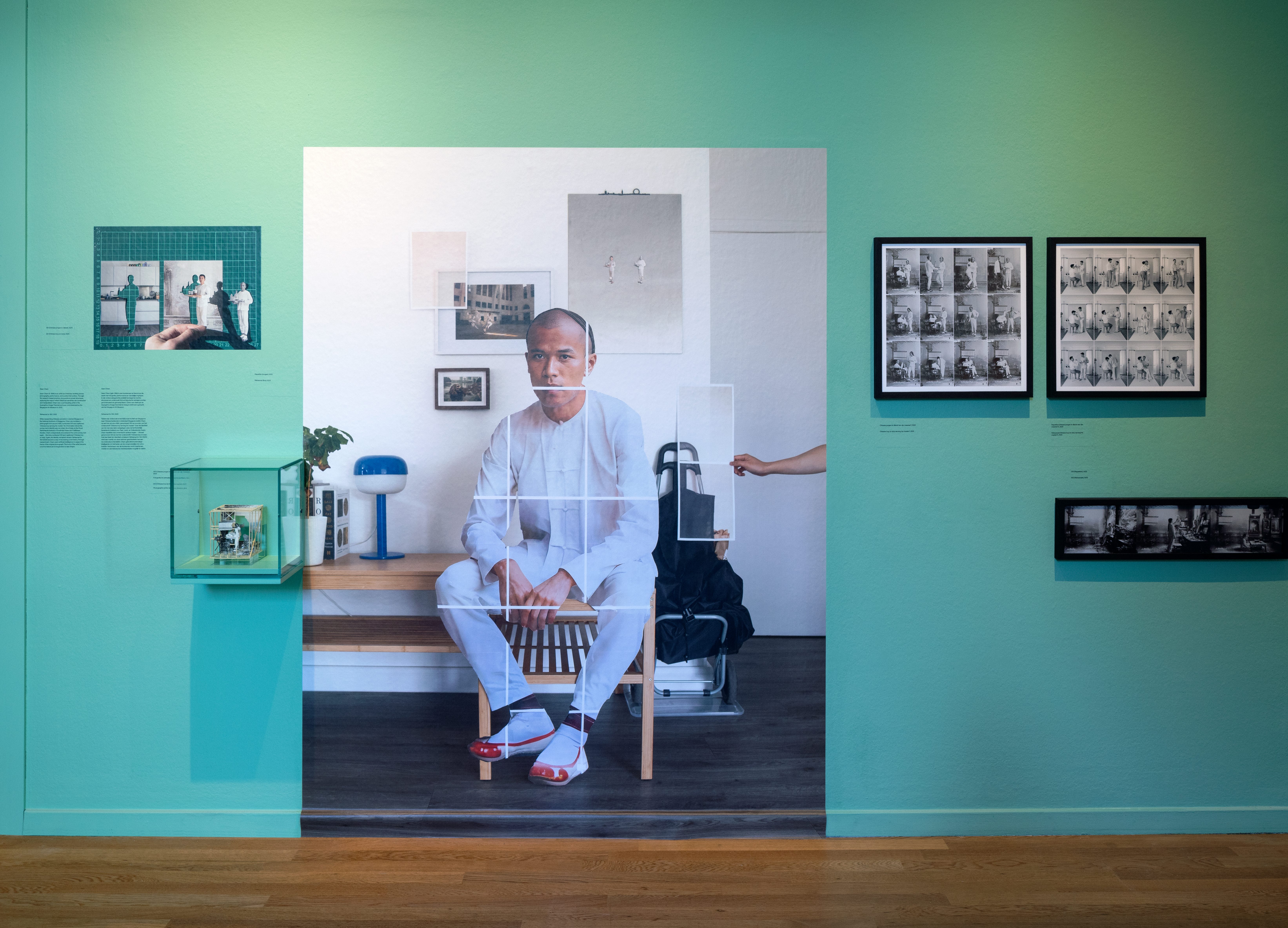
Rehearsal for 302, installation view at Foam, Amsterdam, 2026
Photo: Christian van der Kooy
Cham’s Rehearsal for 302 unfolds as a work of speculative fiction, staging possible iterations to fill the void. The artist’s own body becomes the primary vessel for this exercise, assuming the servant’s role to perform both the gestures and implied hierarchies of the original photographs. Inevitably, the performance also brings Cham’s position — as a Singaporean artist living in London — into subtle focus, carrying its own entanglements with the legacies of empire and migration.
Visually, Cham’s strategies for rehearsing this absent photograph are varied: in his own terms, the project hinges upon combinations of “re-enactment, repetition, juxtaposition, layering, splicing, and projecting.” Isolating and reassembling the images’ details, the flatness of the archive is further prised open. Alongside these manual approaches, digital techniques propel the project into more speculative territory. At times, Cham deploys AI to probe at the limits of the frame itself. Meanwhile, AI-assisted efforts to ‘complete’ the missing 302 place the servant figure in settings that feel conspicuously exoticised — where ornate ‘oriental’ furniture, hanging lanterns and creeping jungle palms echo the visual tropes that Cham dissected in his earlier Eastern Promise series.
In the artist’s mind, there are clear parallels between the workings of AI and the methodologies of a historian. In the simplest terms, both attempt to approximate a coherent picture from a set of data points — but if official records are themselves so skewed by historical biases, granting only partial visibilities, and telling only particular stories on particular terms, how far can the machine imagine beyond these horizons? For Cham, inserting himself into the archive through use of AI tools is a means to underline this feedback loop between images past and present, recalling how the production and distribution of colonial photographs cemented lasting ideas about race, class and labour.
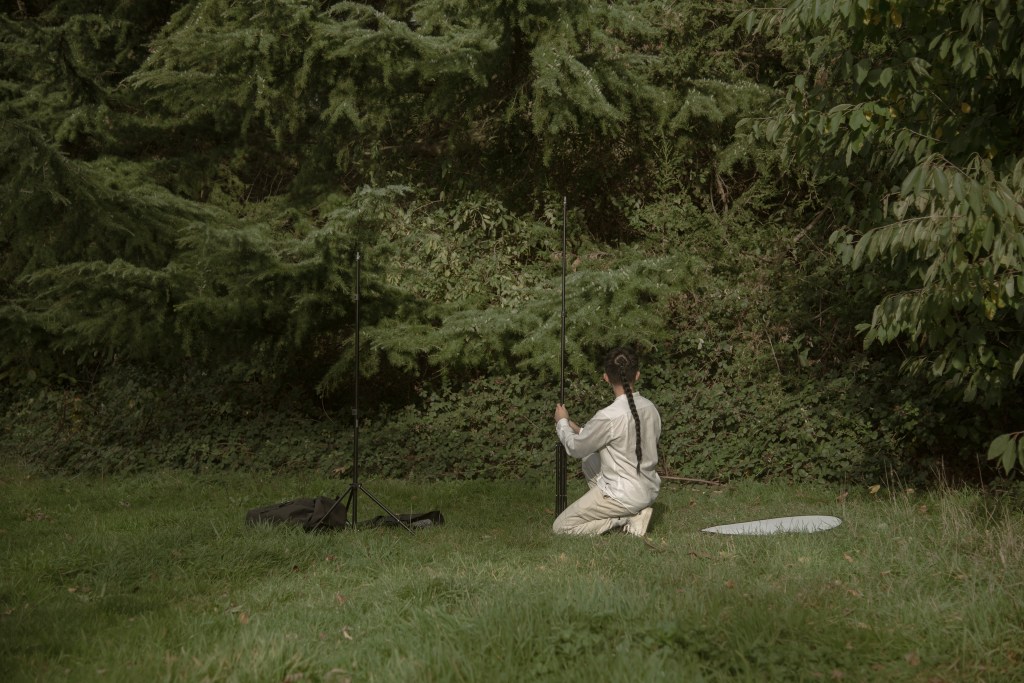
As the series reaches its close, we know little more about the man in the photograph, nor how his story might have ended. Cham’s performances, though, were never conceived as an act of biographical recovery; instead, the servant’s presence circulates through a series of possibilities, freeing him temporarily from the rigid terms of his original depiction. For another image, Cham appears outdoors, dressed once more in the servant’s attire. With his back to camera, he kneels down, setting up a tripod on a lawn flanked by verdant trees. For the first time, the tight confines of the studio give way to open space; acts of authorship, meanwhile, displace those of service. Here in the garden, the frame broadens — there are, it seems, new possibilities still to be rehearsed.
George King, Foam Magazine no.68
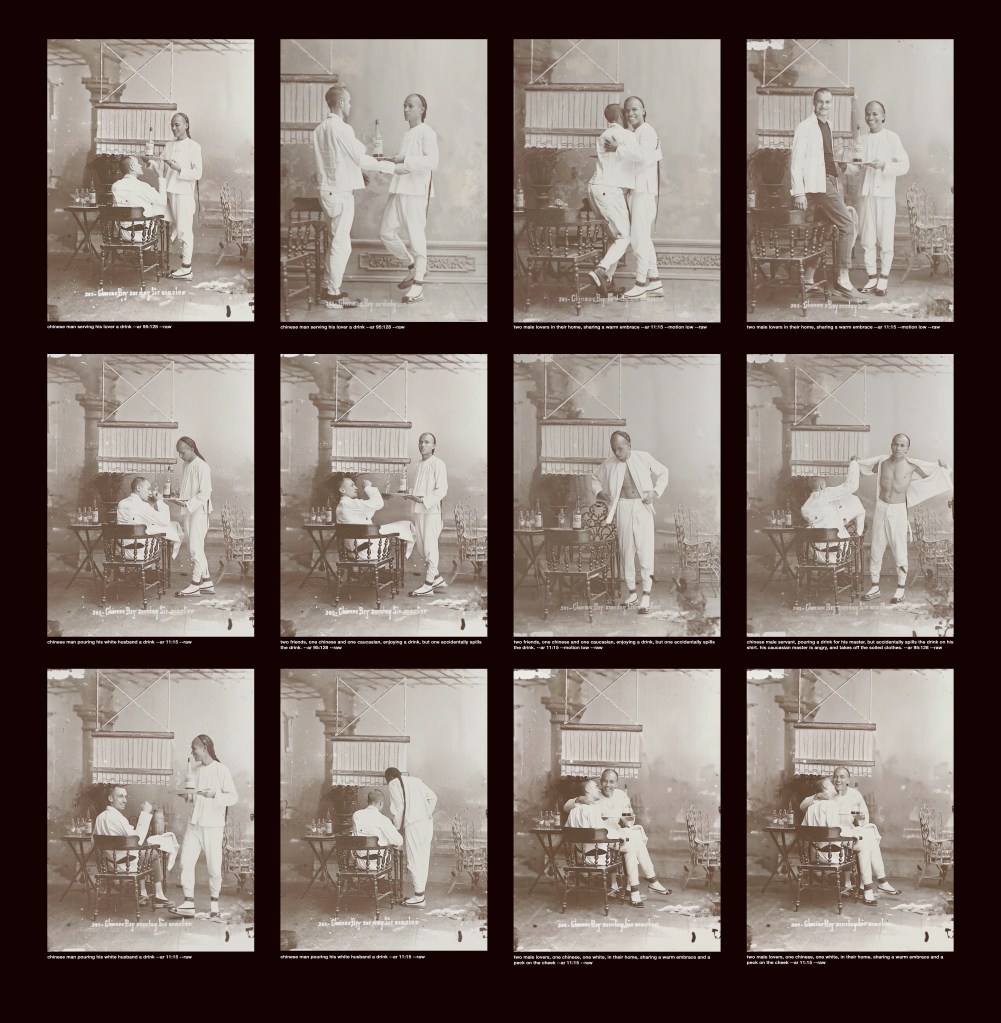
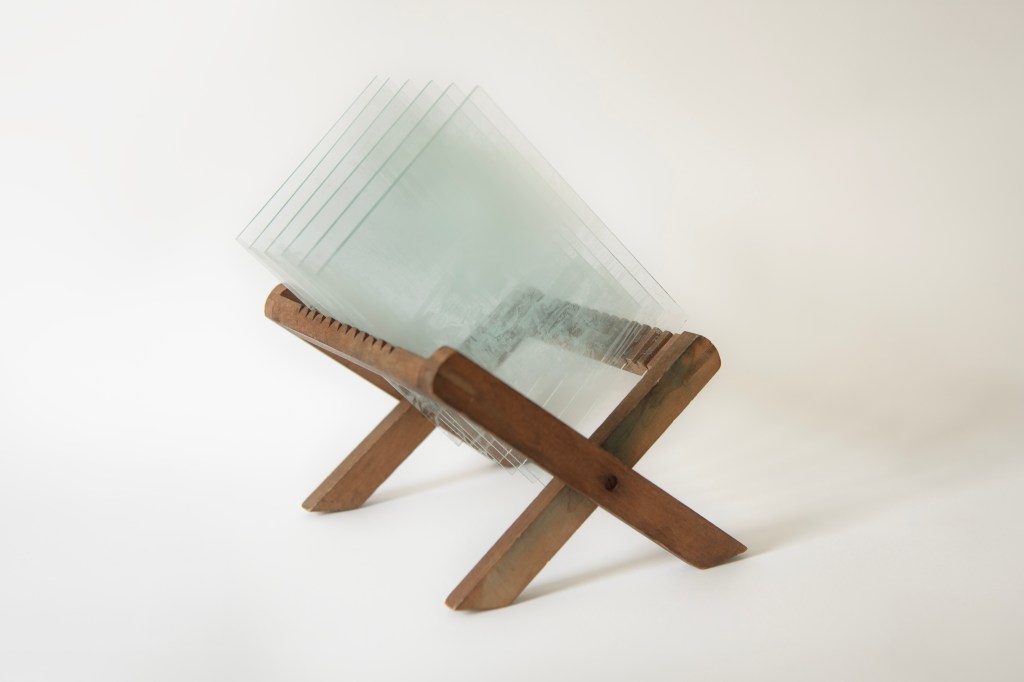
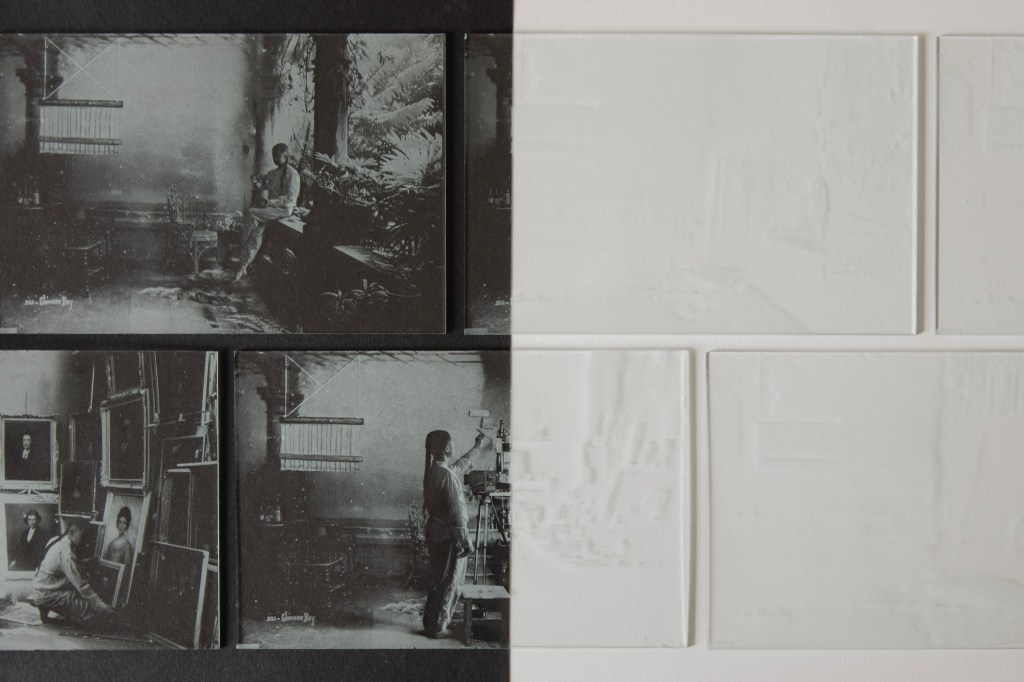
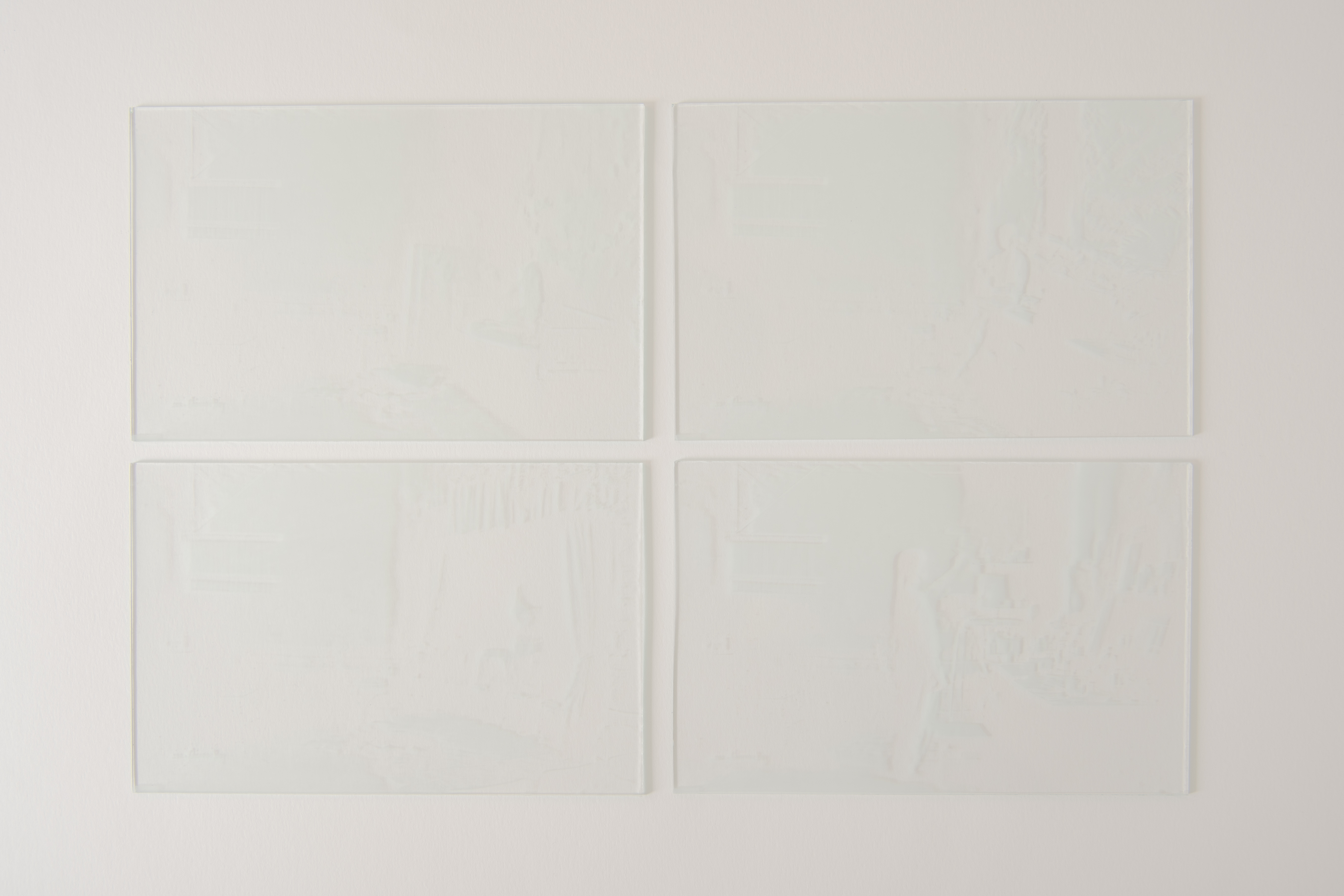
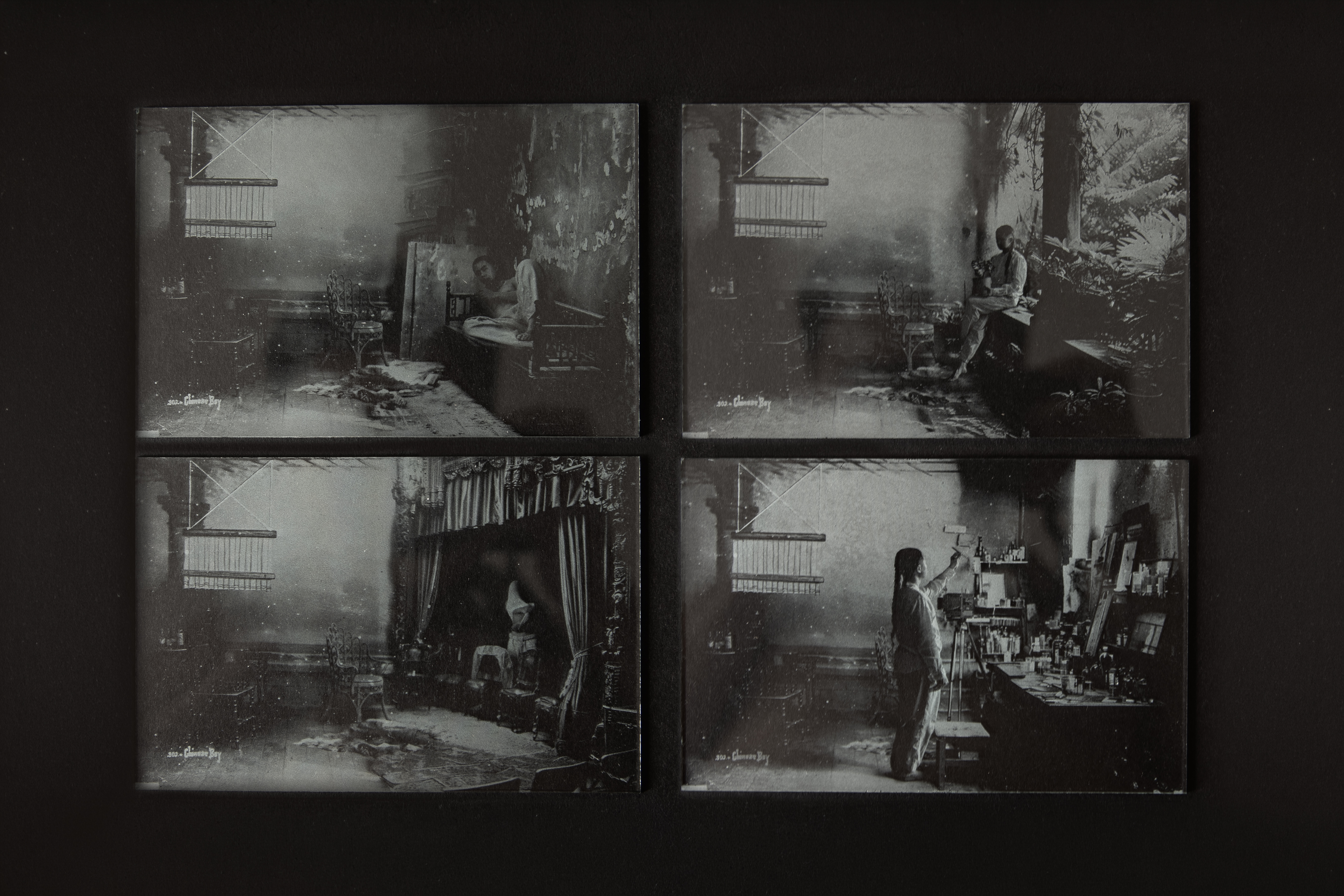
302 (Rehearsals), 2026
UV print on glass, 15.24 x 10.16cm (9 panels, on antique wooden glass plate holder)